Granddaughter is new to the world. It’s still coming into focus – full of possibility, and full of things that need fixing. She can’t see all of it yet, but she doesn’t look away.
She knows the future is long. She knows that what happens now will shape it. She is learning, sometimes slipping up, bringing a naive optimism - yet she feels the weight of her role in making things better.

That's the literal Granddaughter. Now think metaphorically.
In your research, your classroom, your work: what does the future need from you right now? What would you do if you thought generations ahead? What are you still learning that might change everything?

Listen to our young people
Coming soon.
Pattern thinking with Granddaughter
Pattern thinking asks you to hold four perspectives at once, allowing you to see further than any single perspectives allows. These questions will help you find the connections – between perspectives, places, what you know and what you haven’t seen yet.
What happens when Granddaughter's simple solutions are refracted through Eagle, Ant and Grandmother?
What changes when you see the future as yours to shape?
Who else is thinking generations ahead, and are they being taken seriously?
What connections do you see to other entities and places – and where do they lead?
Kin pair
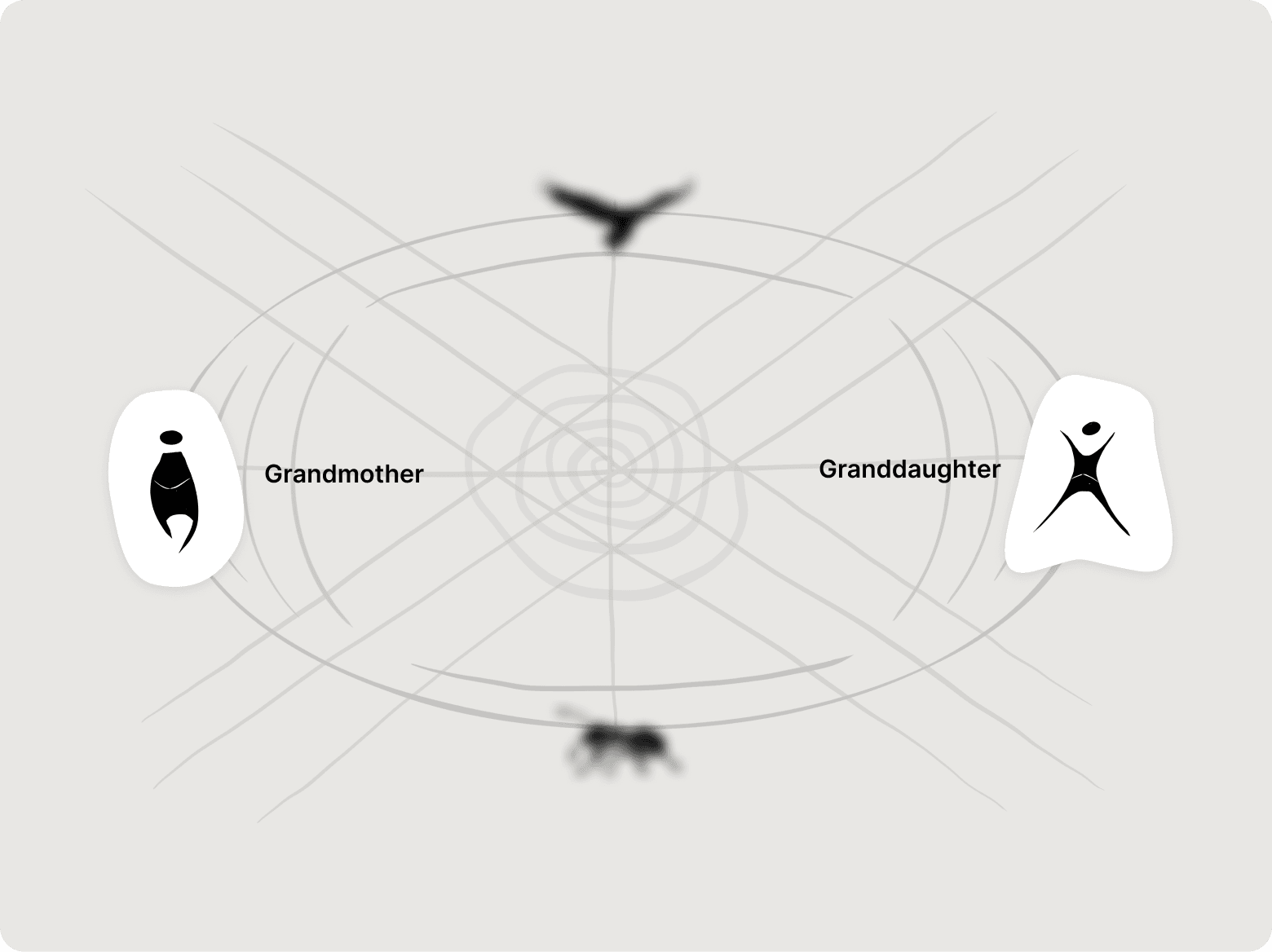
Granddaughter and Grandmother are a kin pair
The two perspectives teach us more together than they do alone. One carries the depth of the past, the other the possibilities of the future. Neither is complete without the other.
In practice
See how others have brought Granddaughter into their research and teaching.
Engaging men and boys in innovative interventions to end gender-based violence
McLachlan, F., & O’Leary, P. (2026)
An Australian Indigenous Knowledge System and Methodology
Raciti, M., Gilbey, K., Manathunga, C., Qi, J. (2026)
It’s Complicated: Roleplaying Development Scenarios with the Kin and Country Framework
Ey, M., & UoN Discipline of Geography and Environmental Studies. (2026)
The Neuroinclusion Project’s Introduction to Neurodiversity: A foundation module for creating inclusive environments for neurodivergent people.
Tan, D., Star, A., Woodington, T., Ezzy, T. (2026)
Waranara (library) Indigenous resource repository
Lumby, N., Vickery, S., Keys, L., Cleary, A., Milliss, E., Tynan, L., Bishop, M., Caldis, S., Mitchell, C. (2026)
Adapting Granddaughter to your Country
Granddaughter is just one name for this perspective. Each Country has its own. For example, on Dharug Country, Aunty Leanne King shares that Granddaughter perspective might belong to the snake – an Entity that represents transformation and growth. As you bring the framework into your own context, listen to the knowledge holders of the Country you’re on. They’ll know who holds Granddaughter’s perspective in their place.
Here are some resources to help you deepen your understanding of the Framework for teaching.
Learn more
How to Adapt the Entities for the Kin and Country Framework
Tynan, L., & Bishop, M. (2026)
How to Build a Scenario for the Kin and Country Framework
Tynan, L., & Bishop, M. (2026)
Teaching Guide for the Kin and Country Framework
Tynan, L., Bishop, M., Milliss, E., Lumby, N., & Rana, L. (2026).
Teaching the Kin and Country Framework with Neurodivergent Learners
Tan, D. W., Tynan, L., & Bishop, M. (2026)